https://www.sefaria.org/Esther.1.1-2?lang=bi
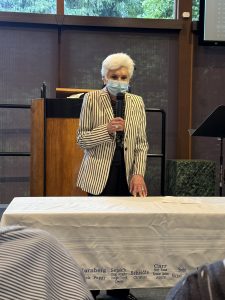
Archie Levine delivered earlier this month at the Solidarity Day held at the ICE detention center.
Before launching into my little talk, I want to thank all of you for coming today. I also want to thank Rabbi James Mirel, who would have been here if he didn’t have prior, out-of-town commitments, for placing his trust & confidence in my ability to speak in his stead. And most importantly, I want to thank La Resistencia for the important work they’ve been doing & for hosting us.
“The alien residing among you must be treated as your native-born. Love them as yourself, for you were foreigners in Egypt. I am the LORD your God.” – Leviticus 19:34
This commandment is repeated multiple times in the Hebrew Bible:
“Do not mistreat or oppress a foreigner, for you were foreigners in Egypt.” – Exodus 22:21
“He defends the cause of the fatherless and the widow, and loves the foreigner residing among you, giving them food and clothing. And you are to love those who are foreigners, for you yourselves were foreigners in Egypt.” – Deuteronomy 10:18–19
The Bible and our long history are replete with episodes of us being driven to foreign lands, being conquered & oppressed in our own land, and persecuted in lands to which we’ve fled.
I have to admit that I haven’t always lived up to these standards. The Jewish people haven’t always lived up to these standards. Even the God of our Bible hasn’t lived up to the standards set forth in the Bible. And I doubt that anyone here has lived up to this standard. We all can and must do better.
History has also taught us that, even if the oppressors don’t come for us first, they will eventually come after us. I’m sure we are all familiar with the poem by Pastor Martin Niemoeller:
First they came for the Communists
And I did not speak out because I was not a Communist…
Last January, on Holocaust Remembrance Day, I sent a reminder to the Bet Chaverim Congregation about Pastor Niemoeller’s poem and stated that his list is incomplete. Before they came for the Communists, they came for the Trans people & other members of the queer community, AND they came for the immigrants.
I say these things as a reminder that, as in all major faith traditions, Empathy, Compassion, and Equality before the Law are our ideals and our guiding principles. I stand here as a human being, and as a Jew to state and affirm that what goes on in this building is not RIGHT! Is not JUST! The fact that these immigrants, PEOPLE like you and me, are held here and at more than 200 other detention centers across the US, AND the way they are treated in them is cruel & inhuman! And none of us, whether we adhere to a faith tradition or not, none of us can tolerate what goes on here. As human beings, we MUST NOT tolerate this…not because we might be next on the chopping block (which we may well be), but because we lose our humanity when we sit back and do nothing. We must raise our voices…we must call or write our congress people and our state representatives…write our newspapers & use our social media…get out on streets and protest…and be here to bear witness.
Thank you.
Thank you Reverend Ryan.
Now, in a moment I will ask all of you to close your eyes and focus inside. But first, if it feels right for you and it’s acceptable to a person next to you, take their hand. If not, just imagine and recognize the presence and support of everyone around you.
And now, close your eyes & focus inside. Focus your attention to all that loving-kindness that you just cultivated…the loving kindness that continues to radiate from your heart to all the people being held captive in the detention center here and in the centers across the country. And draw strength from the people standing next to you. Recognize that you are not alone… WE are here together, supporting each other… And in numbers there is strength. We have the power to make a difference! We, along with the thousands of others across the country… standing together are making a difference!
Take that knowledge…that certainty…that strength that is growing as we grow in number…add to it your measure of loving kindness, and make a commitment to do SOMETHING!
To call or write your congressperson or your state representative!
To write your local paper or post on your social media!
To join some group standing in protest!
Or just voice your opinion to neighbors, friends, and family!
Just one little thing more than you’ve done so far,
Know that we are making a difference!
Thank you!
Although according to Jewish custom Hanukkah is considered a “minor” Jewish festival, today it ranks—along with Passover and Purim—as one of the most beloved Jewish holidays, full of light and joy and family celebration.
Unlike many Jewish holidays, Hanukkah (also known as the Festival of Lights) is not mentioned in the Bible. The historical events upon which the celebration is based are recorded in Maccabees I and II, two books contained within a later collection of writings known as the Apocrypha.
In the year 168 B.C.E., the Syrian king Antiochus Epiphanes sent his soldiers to Jerusalem. The Syrians desecrated the Temple, the holiest place for Jews at that time. Antiochus also abolished Judaism, outlawing the observance of Shabbat and the festivals, as well as circumcision. Altars and idols were set up for the worship of Greek gods, and he offered Jews two options: conversion or death.
On the 25th day of the Hebrew month of Kislev in 168 B.C.E., the Temple was renamed for the Greek god Zeus. A Jewish resistance movement – led by a priestly family known as the Hasmoneans, or Maccabees – developed, resisting the cruelty of Antiochus. The head of the family was Mattathias, an elderly man. His son, Judah, became the chief strategist and military leader of the resistance. Though outnumbered, Judah Maccabee and his fighters miraculously won two major battles, routing the Syrians decisively.
Although historians debate the causes and outcomes of the war in which Judah Maccabee and his followers defeated the Syrian armies of Antiochus, there is no doubt that Hanukkah evokes stirring images of Jewish valor against overwhelming odds. Other themes of the holiday include the refusal to submit to the religious demands of an empire practicing idolatry, the struggle against total assimilation into Greek culture and loss of Jewish identity, and the fight for Jewish political autonomy and self-determination.
Hanukkah, which means “dedication,” is the festival that commemorates the purification and rededication of the Temple following the Greek occupation of that holy place. Today, the holiday reminds Jews to rededicate themselves to keeping alive the flame of Jewish religion, culture, and peoplehood so that it may be passed on to the next generation.
Originally, the eight-day holiday was intended to parallel the eight-day festival of Sukkot. The books of the Maccabees made no mention of the legend concerning a small jar of oil that unexpectedly lasted for eight days. Only centuries after the Maccabees’ defeat of the Syrians did the story of the jar of oil – which has come to be associated with Hanukkah – appear in the Talmud.
According to the legend, when the Maccabees entered the Temple and began to reclaim it from the Greeks, they immediately relit the , which burned constantly in the Temple and has a parallel in our synagogues to this day. In the Temple, they found a single jar of oil, which was sufficient for only one day. The messenger who was sent to secure additional oil took eight days to complete his mission, and miraculously, the single jar of oil continued to burn until his return. The rabbis of the Talmud attributed the eight days of Hanukkah to the miracle of this single jar of oil.
Although the practice of lighting the (also called a ) was common throughout much of the 19th century, North American Jews tended to neglect most of the other traditions and practices associated with the holiday. By the 1920s, however, Jews increasingly added gift-giving to their Hanukkah celebrations, prompting some people to refer to Hanukkah as the “Jewish Christmas.”
In some ways, the transformation of Hanukkah was linked to the growth of North American Jewry within its unique environment. The elevation of Hanukkah to a major holiday was partly the result of Jews acculturating themselves to a North America that was overwhelmingly Christian in population and symbols.
Although Hanukkah had become an important holiday among North American Jews by the 1920s, it would be incorrect to regard it as an imitation of Christmas with an emphasis on the exchange of presents. Rather, North American Jews use this holiday as a celebration of family, reinforcing Jewish identity in a place whose population may be overwhelmingly Christian. Hanukkah is a means for North American Jews to feel a kinship with their neighbors while simultaneously asserting their Jewish distinctiveness.
< I FOUND I COULD ADD THE APP JLTV TO MY ROKU TV DEVICE. NO CHARGE FOR USE SO FAR , CARMI>
When the world shut down during the global pandemic in 2020, Jewish Life Television realized that Jews around North America would lose the chance to gather every Friday night for Shabbat Services. Given this reality, JLTV executives recognized that, since JLTV was the largest and most robust 24/7 English-language, Jewish-themed television network on the continent, it had the opportunity, even the obligation, to provide religious and spiritual support to its millions of viewers by producing and programming a weekly Shabbat Celebration.
JLTV’s Executive Vice President Brad Pomerance reached out to Rabbi Mark Blazer, the Executive Director of the Jewish Life Foundation, an independent, non-profit organization that produces and distributes Jewish-themed television programming. Rabbi Blazer agreed to take on the task, and in the spring of 2020, JLTV began to broadcast a one-hour weekly Shabbat experience that aired every Friday evening during the pandemic.
While these weekly Shabbat Services were very well-received by JLTV’s audience, neither the JLF nor JLTV anticipated that the Services would become so popular that, as the pandemic began to wind down, JLTV would receive feedback from Jewish and non-Jewish viewers alike, asking that the network continue its weekly Shabbat programming. As a result, JLTV asked, and the JLF agreed to continue producing weekly Shabbat Services for the network. Rabbi Blazer decided that if the JLF was going to continue to produce weekly Shabbat Services that would air throughout North America, he wanted those Shabbat Celebrations to reflect the diversity of North America’s Jewish community.
To meet that goal, the JLF has produced and JLTV has broadcast its Shabbats from Greenville, Houston, Los Angeles, Nashville, New York, Palm Beach, Phoenix, Seattle, and San Francisco. In April 2025, the Religion Communicator Council honored the JLF, JLTV, and Congregation Micah in Greater Nashville, Tennessee, for its production and broadcast of A Music City U.S.A. Shabbat. In the coming months, the JLF will be traveling to Boston and Columbus to produce Shabbat programming that will air on JLTV. The JLF has also produced special Shabbats when Shabbat has fallen on American Independence Day, Hanukkah, and Sukkot.
As the Jewish community welcomed the Jewish New Year earlier this month, the JLF announced a new brand for its Shabbat Services airing on JLTV – Shabbat Sessions. In addition to providing geographic diversity through its Shabbat programming, the JLF is redoubling its commitment to feature outstanding musical talent on these Services, focused not only on spirituality but also on musicality. The JLF is working with first-rate talent from the Jewish music world, including Joe Buchanan, Neshama Carlebach, Todd Herzog, Chava Mirel, Duvid Swirsky, and many more, and welcoming accomplished musicians who specialize in a variety of musical genres and styles.”
JLTV’s weekly Friday Night Shabbat Services, Shabbat Sessions, air every Friday at 7:00 PM ET and 10:00 PM ET.
JLTV is North America’s largest and most robust 24/7, English language, Jewish-themed television network, available in over 100 million homes through Charter/Spectrum, Comcast/Xfinity, Cox, DirecTV, Prime Video, Vizio, Xumo, and other traditional and non-traditional video providers.
Where to watch JLTV? Find out here!
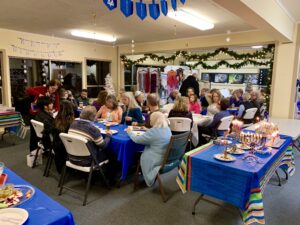
When: Saturday, December 20th – 2:00 to 5:00 PM
Where: Bet Chaverim Welcome Room and Sanctuary
Come play games, listen to a story, dance, sing, and eat latkes, salads and donuts. We will be singing along with the New Shalom Klezmer Band.
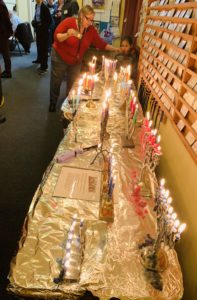
Please bring a salad to share, your Hanukkah menorah and candles.
Don’t forget to bring your toiletry kit donation for the Jewish Family Services Refugee Resettlement program and the Polack Food Bank. See the bulletin article for details.


In Des Moines, Washington, Congregation Bet Chaverim is using URJ resources and implementing principles of sacred partnership to connect with each other and URJ congregations across the country. Rabbi James Mirel and congregational president Geoff Groshong both spoke on a panel at the URJ’s January 2025 Leadership Bootcamp and shared their thoughts about cultivating sacred partnerships. Rabbi Mirel shared that being part of the URJ has allowed the congregation to build relationships, maintain connections across the country, and be part of something big.
Rabbi Mirel believes that the real sacred partnership is between the congregation and God, leaders are just there to facilitate it. Thus, the leadership structure at Congregation Bet Chaverim values the voices of all members. He explained, “I personally respect everyone’s point of view and feel they should be heard. We all share equal responsibility [in our mission] to be a kehillah kedosha, a holy congregation.”
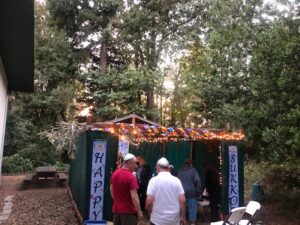
The first two days (sundown on October 6 until nightfall on October 8 in 2025) of the holiday (one day in Israel) are yom tov, when work is forbidden, candles are lit in the evening, and festive meals are preceded by Kiddush and include challah dipped in honey.
The intermediate days (nightfall on October 8 until sundown on October 13 in 2025) are quasi holidays, known as Chol Hamoed. We dwell in the sukkah and take the Four Kinds every day of Sukkot (except for Shabbat, when we do not take the Four Kinds).
The final two days (sundown on October 13 until nightfall on October 15 in 2025) are a separate holiday (one day in Israel): Shemini Atzeret / Simchat Torah.
Of all the Jewish holidays, Sukkot is the only one whose date does not seem to commemorate a historic event. The Torah refers to it by two names: ChagHaAsif (“the Festival of Ingathering,” or “Harvest Festival”) and Chag HaSukkot (“Festival of Booths”), each expressing a reason for the holiday.
In Israel, crops grow in the winter and are ready for harvest in the late spring. Some of them remain out in the field to dry for a few months and are only ready for harvest in the early fall. Chag HaAsif is a time to express appreciation for this bounty.
The name Chag HaSukkot commemorates the temporary dwellings G‑d made to shelter our ancestors on their way out of Egypt (some say this refers to the miraculous clouds of glory that shielded us from the desert sun, while others say it refers to the tents in which they dwelled for their 40-year trek through the Sinai desert).


Israel’s Independence Day is celebrated on the fifth day of the month of Iyar, which is the Hebrew date of the formal establishment of the State of Israel, when members of the “provisional government” read and signed a Declaration of Independence in Tel Aviv. The original date corresponded to May 14, 1948.
Most of the Jewish communities in the Western world have incorporated this modern holiday into their calendars, but some North American Jewish communities hold the public celebrations on a following Sunday in order to attract more participation. In the State of Israel it is a formal holiday, so almost everyone has the day off.
Yom Ha’atzmaut in Israel is always preceded by Yom Hazikaron, Israel’s Memorial Day for the fallen soldiers. The message of linking these two days is clear: Israelis owe their independence — the very existence of the state — to the soldiers who sacrificed their lives for it.