Yehudi – Judah
The term Jew is derived from Hebrew יְהוּדִי Yehudi, originally the term for the people of the Israelitekingdom of Judah. According to the Hebrew Bible, the name of both the tribe of Judah and the kingdom of Judah derive from Judah, the fourth son of Jacob.[48] Genesis 29:35 and 49:8 connect the name “Judah” with the verb yada, meaning “praise”, but scholars generally agree that the name of both the patriarch and the kingdom instead have a geographic origin—possibly referring to the gorges and ravines of the region.[49][50] The shift of ethnonym from “Israelites” to “Jews” (inhabitant of Judah), although not contained in the Torah, is made explicit in the Book of Esther (4th century BCE),[51] a book in the Ketuvim, the third section of the Jewish Tanakh.
The Hebrew word for “Jew” is יְהוּדִי Yehudi, with the plural יְהוּדִים Yehudim.[52] Endonyms in other Jewish languages include the Ladino ג׳ודיו Djudio (plural ג׳ודיוס, Djudios) and the Yiddish ייִד Yid (plural ייִדן Yidn).
The English word “Jew” continues Middle English Gyw, Iewe. These terms were loaned via the Old Frenchgiu, which itself evolved from the earlier juieu, which in turn derived from judieu/iudieu which through elisionhad dropped the letter “d” from the Medieval Latin Iudaeus, which, like the New Testament Greek term Ioudaios, meant both “Jew” and “Judean” / “of Judea“.[53] The Greek term was a loan from Aramaic*yahūdāy, corresponding to Hebrew יְהוּדִי Yehudi.[48]
The etymological equivalent is in use in other languages, e.g., يَهُودِيّ yahūdī (sg.), al-yahūd (pl.), in Arabic, “Jude” in German, “judeu” in Portuguese, “Juif” (m.)/”Juive” (f.) in French, “jøde” in Danish and Norwegian, “judío/a” in Spanish, “jood” in Dutch, “żyd” in Polish etc., but derivations of the word “Hebrew” are also in use to describe a Jew, e.g., in Italian (Ebreo), in Persian (“Ebri/Ebrani” (Persian: عبری/عبرانی)) and Russian(Еврей, Yevrey).[54] The German word “Jude” is pronounced [ˈjuːdə], the corresponding adjective “jüdisch” [ˈjyːdɪʃ] (Jewish) is the origin of the word “Yiddish”.[55]
According to The American Heritage Dictionary of the English Language, fourth edition (2000),
It is widely recognized that the attributive use of the noun Jew, in phrases such as Jew lawyer or Jew ethics, is both vulgar and highly offensive. In such contexts Jewish is the only acceptable possibility. Some people, however, have become so wary of this construction that they have extended the stigma to any use of Jew as a noun, a practice that carries risks of its own. In a sentence such as There are now several Jews on the council, which is unobjectionable, the substitution of a circumlocution like Jewish people or persons of Jewish background may in itself cause offense for seeming to imply that Jew has a negative connotation when used as a noun.[56]
Stolperstein
Stolpersteine for the Feder family in Kolín, Czech Republic
Stolperstein installation in AmsterdamBeethovenstraat 55 on 3 October 2018
A Stolperstein is a ten-centimetre (3.9 in) concrete cube bearing a brass plate inscribed with the name and life dates of victims of Nazi extermination or persecution. Literally, it means ‘stumbling stone’ and metaphorically ‘stumbling block’. (pronounced [ˈʃtɔlpɐˌʃtaɪn] (
listen); plural Stolpersteine)
The Stolpersteine project, initiated by the German artist Gunter Demnig in 1992, aims to commemorate individuals at exactly the last place of residency – or, sometimes, work – which was freely chosen by the person before they fell victim to Nazi terror, forced euthanasia, eugenics, deportation to a concentration or extermination camp, or escaped persecution by emigration or suicide. As of December 2019, 75,000[1]Stolpersteine have been laid, making the Stolpersteine project the world’s largest decentralized memorial.[2][3]
The majority of Stolpersteine commemorate Jewish victims of the Holocaust.[4] Others have been placed for Sinti and Romani people (then also called “gypsies”), Poles, homosexuals, the physically or mentally disabled, Jehovah’s Witnesses, black people, members of the Communist Party, the Social Democratic Party, and the anti-Nazi Resistance, the Christian opposition (both Protestants and Catholics), and Freemasons, along with International Brigade soldiers in the Spanish Civil War, military deserters, conscientious objectors, escape helpers, capitulators, “habitual criminals”, looters, and others charged with treason, military disobedience, or undermining the Nazi military, as well as Allied soldiers.
Origin of the name
The name of the Stolpersteine project invokes multiple allusions. In Nazi Germany, an antisemitic saying, when accidentally stumbling over a protruding stone, was: “A Jew must be buried here”.[5][6] In a metaphorical sense, the German term Stolperstein can mean “potential problem”.[7] The term “to stumble across something”, in German and English, can also mean “to find out (by chance)”.[8] Thus, the term provocatively invokes an antisemitic remark of the past, but at the same time intends to provoke thoughts about a serious issue. Stolpersteine are not placed prominently, but are rather discovered by chance, only recognizable when passing by at close distance. In contrast to central memorial places, which according to Demnig can be easily avoided or bypassed, Stolpersteine represent a much deeper intrusion of memory into everyday life.
next events
May and June schedule:
On Friday, May 26th, Shavuot will be celebrated. Neil will be at the service, Maya will read from the Torah.
Pride Shabbat will be celebrated on June 23rd at 5:30 PM at Temple De Hirsch – it will also be on Zoom.
There will be a genealogy hybrid presentation on June 19th at the Alpert’s house at 7 PM.
Annual Meeting: The annual meeting will be in person and on Zoom on June 25th.
Holidays for next year:
- Friday, Sept 15th – erev RH
- Saturday, Sept. 16th – RH day
- Sunday, Sept. 24th – Kol Nidre
- Monday, Sept. 25th – YK day
- Sunday, Oct. 1st – Sukkot celebration and potluck in the afternoon
- Friday, Oct. 6th – Simchat Torah
- Wed., Nov 22nd – Interfaith service at Presbyterian church in Des Moines.
- Saturday, Dec. 9th – Chanukkah party – 4:30
- Saturday, March 23rd – Purim celebration 7 PM
- Tues, 4/23 – Community Seder
- Shavuot – to be determined
Dues
Pledge Levels – Yearly ( contact treasurer for discussion of dues)
Amudim (Pillars)
- Rate for Single: $1,840
- Rate for Family: $2,760
Shomrim (Guardians)
- Rate for Single: $1,380
- Rate for Family: $2,070
Tomchim (Supporters) Income <=$40,000
- Rate for Single: $690
- Rate for Family: $1035
Bonim (Builders) <= 35
- Rate for Single: $276
- Rate for Family: $414
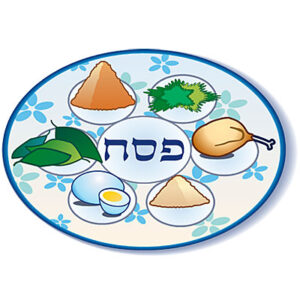
Passover 2023

Community Passover Seder on Friday, April 7th at 6 PM. Sixty people is our limit so if you are planning on attending and haven’t registered yet, please do so soon. The price for the Seder is: $30 Adult Member, $35 Adult Non-Member, $10 for children 12 and under. The Seder will be led my Rabbi Mirel at the synagogue — 25701 14th Pl. S., Des Moines. It will be catered by On Safari with traditional foods made by congregation members.
ADAR
Rosh Chodesh Adar 2023 / רֹאשׁ חוֹדֶשׁ אַדָר 5783
Start of month of Adar on the Hebrew calendar 🌒
Rosh Chodesh Adar for Hebrew Year 5783 begins at sundown on and ends at nightfall on .
Start of month of Adar on the Hebrew calendar. Adar (אַדָר) is the 12th month of the Hebrew year, has 29 days, and corresponds to February or March on the Gregorian calendar. רֹאשׁ חוֹדֶשׁ, transliterated Rosh Chodesh or Rosh Hodesh, is a minor holiday that occurs at the beginning of every month in the Hebrew calendar. It is marked by the birth of a new moon.
Hannukah music
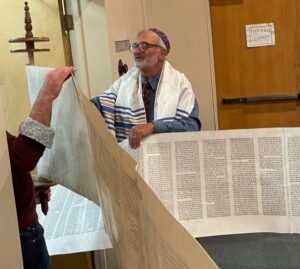
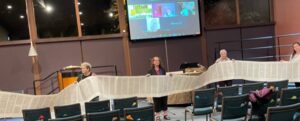
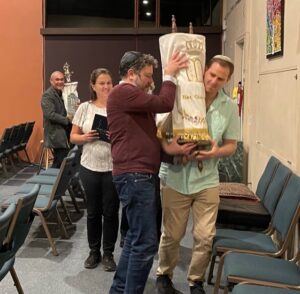
Simcha Torah 2022
Simcha Torah

sukkot 2022